

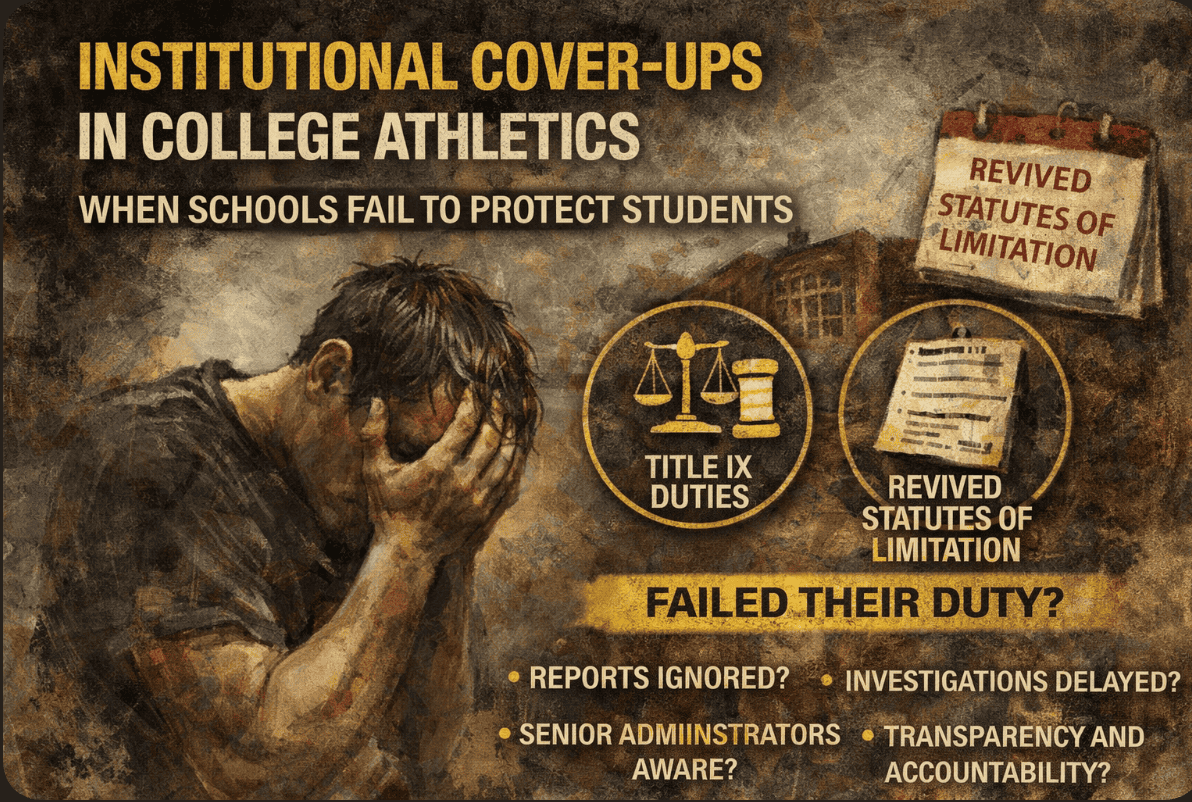
Across the country, investigations and litigation have revealed troubling patterns in which colleges and universities allegedly failed to act on reports of sexual abuse and misconduct involving student-athletes.
While each case turns on its own facts, recurring themes have emerged: breakdowns in reporting structures, delayed investigations, internal handling of complaints, and institutional reputational concerns overriding student safety.
The Legal Duty of Colleges and Universities
Colleges and universities owe students a duty to provide a reasonably safe educational environment. That duty can arise under:
- Title IX of the Education Amendments of 1972
- State negligence law
- Mandatory reporting statutes
- Internal policies and student-athlete handbooks
When institutions receive credible reports of abuse or misconduct, they are expected to take prompt and appropriate action. Failure to do so may expose the institution to civil liability.
Common Institutional Failure Patterns
In past litigation nationwide, plaintiffs have alleged:
- Complaints were minimized or not escalated
- Reporting hierarchies were unclear or ignored
- Senior administrators were notified but failed to intervene
- Athletic departments operated without adequate oversight
- Internal investigations were delayed or incomplete
Importantly, liability does not require that every administrator had full knowledge. Courts often examine whether the institution, through its agents, had sufficient notice and responded reasonably.
Statutes of Limitation and Revival Laws
Many states have extended or temporarily revived statutes of limitation for survivors of childhood sexual abuse. These “lookback windows” have allowed previously time-barred claims to proceed.
Because deadlines vary significantly by state, individuals who believe they may have a claim should not assume it is too late without seeking legal advice.
Accountability and Transparency
Litigation involving institutional misconduct often serves two purposes:
- Providing compensation to survivors
- Promoting transparency and institutional reform
Civil discovery can uncover internal communications, reporting practices, and decision-making processes that were not previously disclosed.
What Survivors Should Know
Every situation is different. Survivors considering legal action may wish to evaluate:
- When the misconduct occurred
- Whether reports were made and to whom
- Whether the institution conducted an investigation
- The applicable statute of limitations
- The jurisdiction’s treatment of institutional liability
Sauder Schelkopf represents individuals and families in complex institutional accountability litigation. If you believe a college, university, or athletic program failed to protect students from abuse or misconduct, our team can confidentially evaluate your situation.
Disclaimer: The information provided in this blog post is for general informational purposes only and does not constitute legal advice. Reading this post does not create an attorney-client relationship between you and Sauder Schelkopf. Laws vary by jurisdiction, and the application of law depends on individual circumstances. You should not act or rely on any information in this post without seeking professional legal counsel. If you need legal assistance, please contact a qualified attorney to discuss your specific situation.